Fragmented
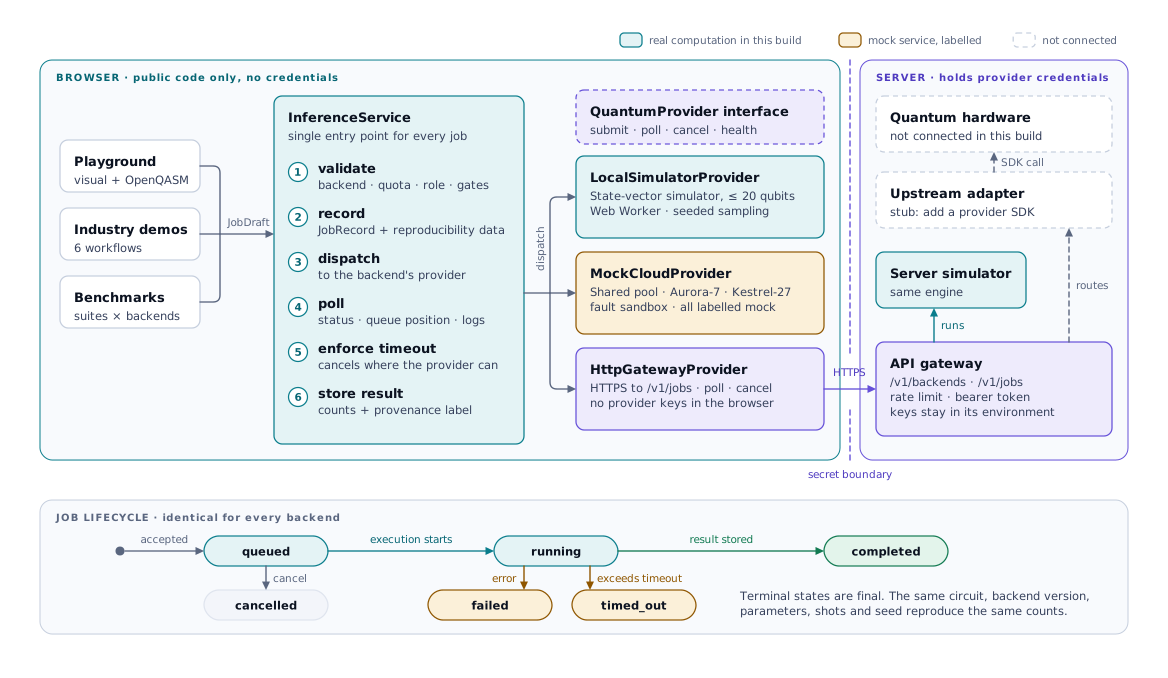
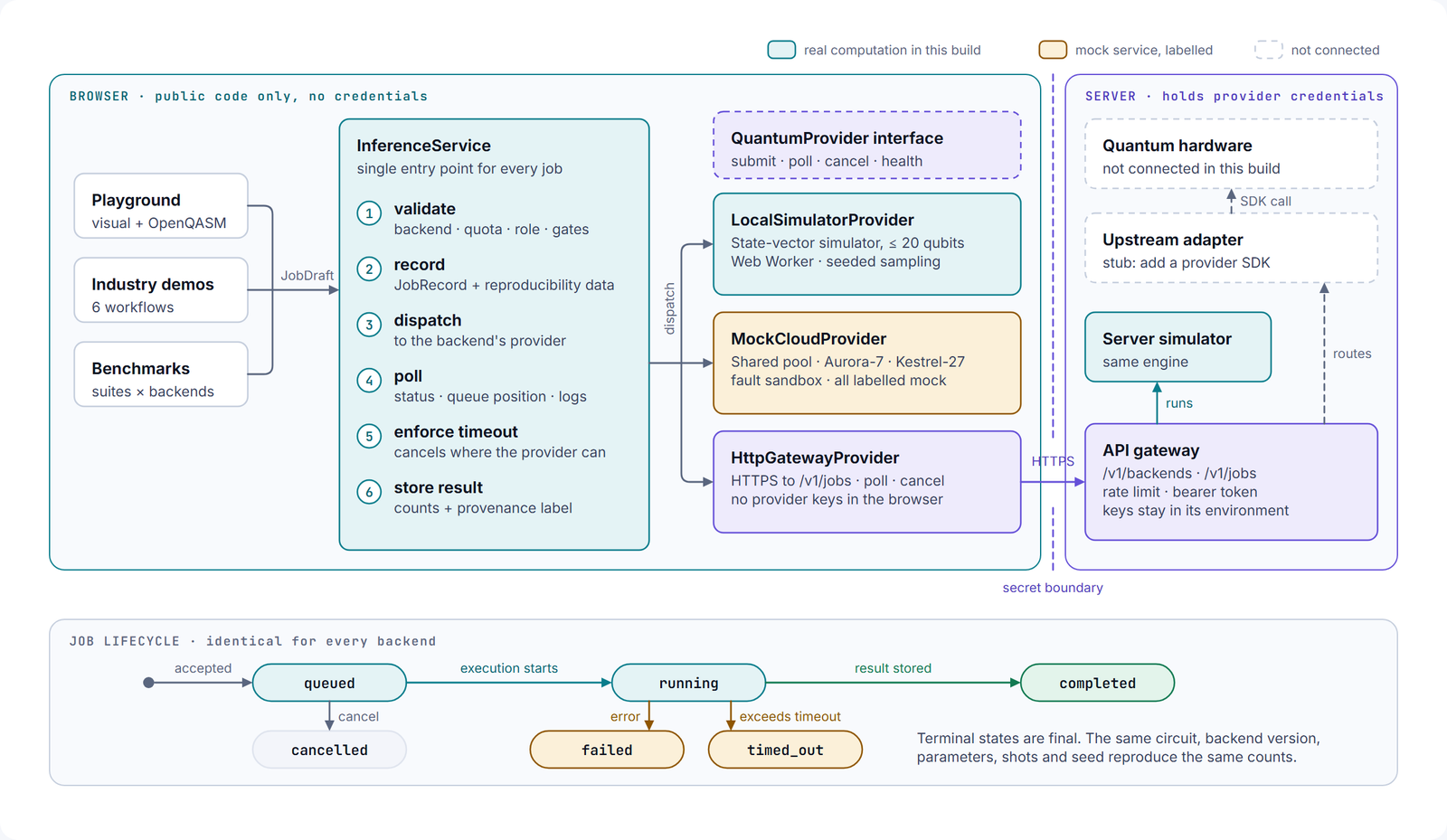
Every vendor has its own SDK, account, queue and result format. QubitHub puts one job interface in front of them.
The open quantum computing commons
A community platform for researchers, developers and businesses: a catalog of reusable circuits, models and datasets, a browser Playground, a provider-agnostic job API, benchmarks and reproducible reports.
Computations run on a classical simulator, in your browser or on the QubitHub server. No quantum hardware or payments are involved; catalog entries and statistics are labelled sample data.
Why a commons
QubitHub is one vendor-neutral place to discover, build, run, compare and share quantum workloads.
Every vendor has its own SDK, account, queue and result format. QubitHub puts one job interface in front of them.
Circuits, models and benchmarks are scattered across papers and repositories. The catalog gives them versions, licences and a place to be found.
A result is of little use without the circuit, backend version, parameters, shots and seed that produced it. Every QubitHub job records all of them.
Product areas
Each area sits behind a replaceable service interface: simulators today, real providers through a gateway when they are connected.
Submit jobs through one interface to the in-browser simulator, a shared pool, a noisy device profile, a fault-injection sandbox or a remote gateway. Validation, queues, cancellation, timeouts, logs and results.
Providers and backends with capability metadata: gates, qubits, coupling map, calibration timestamp and availability, plus service health and queues.
A searchable catalog of models, circuits, algorithms, datasets, benchmarks and projects with tags, versions, licences, files, examples and results with provenance.
Visual and OpenQASM circuit editing with parameters, shots, seeds and backends. Counts, state vector, Bloch components, logs and metadata; save, share and export.
Recent jobs and projects, usage against quota and alerts. Job, project and benchmark reports with a reproducibility appendix, CSV and JSON export and a print view.
Accounts approved by a super admin, roles from Viewer to Owner, an admin console with access requests, users and an audit log, and light, dark and high-contrast themes.
Try it
This runner uses the same approach as the QubitHub Playground: a dense state-vector simulation with seeded shot sampling, so the same seed always returns the same counts.
A real state-vector simulation, computed in your browser. The same engine runs the QubitHub Playground.
Quantum Inference
The Playground, the industry demos and the benchmarks all submit the same job draft. Validation runs on every edit, so an unavailable backend, an unsupported gate or an exceeded quota shows before anything is submitted.
Each result shows one of four provenance labels and the time of its last run. Reports count the labels and state plainly that no value comes from quantum hardware.
Industry demos
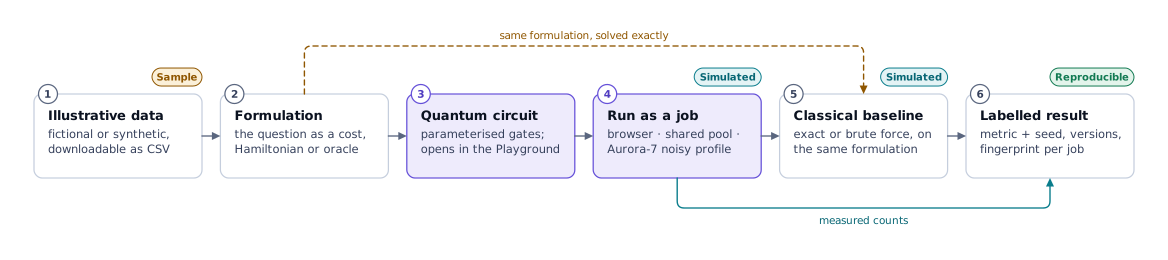
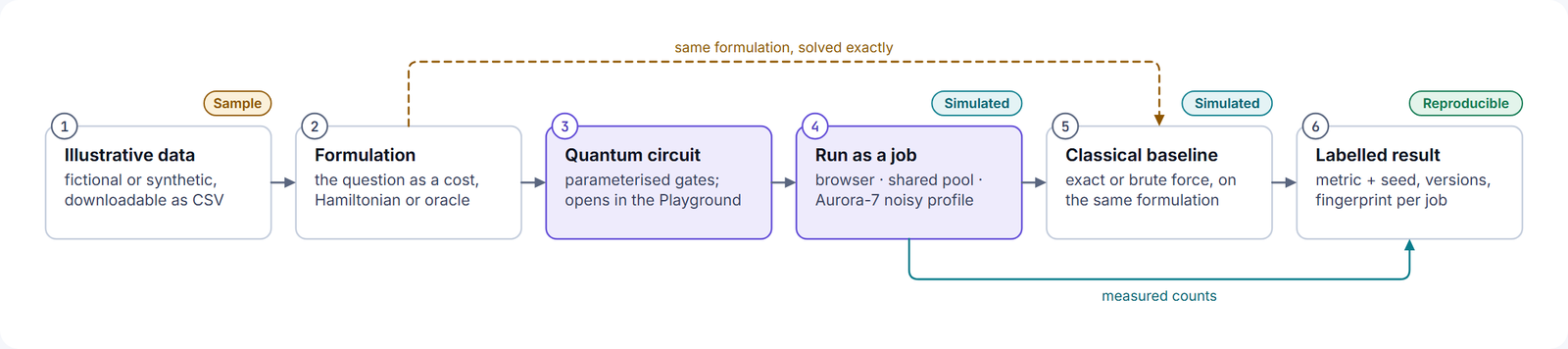
Runnable, clearly labelled workflows with illustrative data and stated limitations. Each one ends with the quantum result next to an exact classical answer.
Pick 2 of 4 fictional assets, balancing expected return against risk.
Compare a ZZ feature-map kernel with a classical RBF kernel on 12 synthetic samples.
Find enzyme variants that meet two design thresholds among 16 combinations.
Split a 6-gene dissimilarity network into two modules with QAOA.
Trotterised time evolution of 4 spins compared with exact diagonalisation.
A one-parameter variational eigensolver on the textbook two-qubit hydrogen Hamiltonian.
All datasets are fictional or synthetic and all results are classical simulations. Every problem is small enough to solve classically. The demos show the workflow and its limits; they make no medical, financial, scientific or performance claims.
Access and sign-in
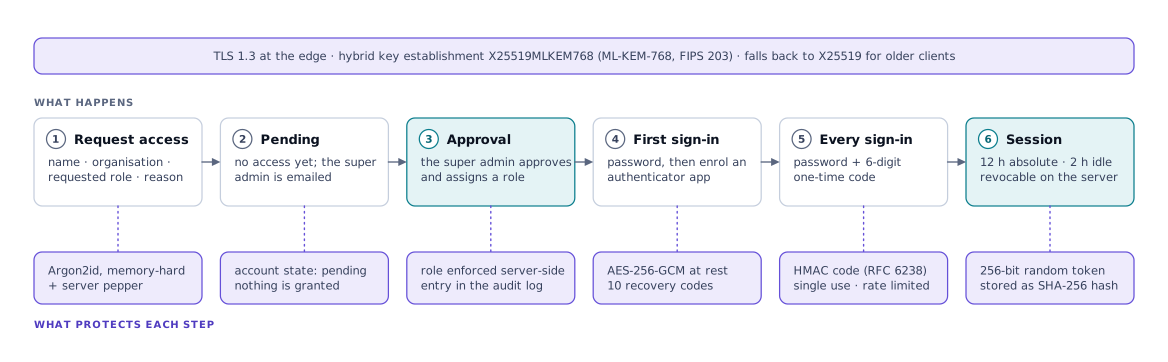
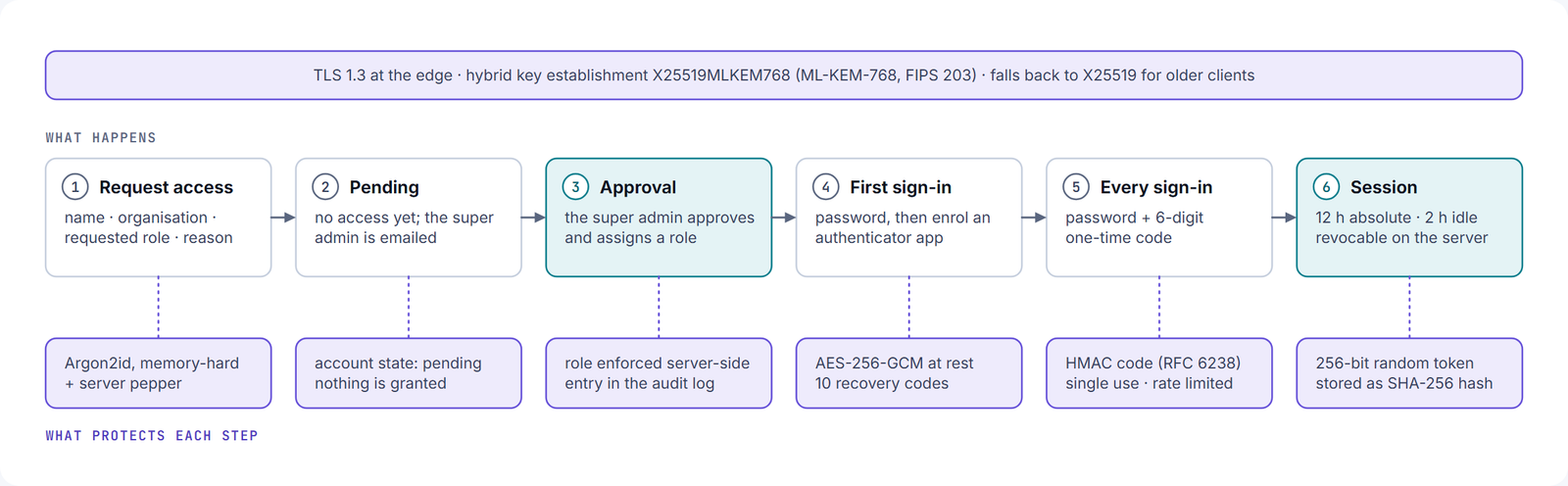
New accounts stay pending until the super admin approves them and assigns a role. Every sign-in needs a password and a six-digit one-time code from an authenticator app.
A role is assigned on approval and can be changed by the super admin. A Viewer who tries to submit a job is refused by the server, not only by the interface.
The certificate signature at the edge is still classical: public certificate authorities do not yet issue post-quantum certificates. Hybrid key establishment protects against recording traffic now and decrypting it later, not yet against an active attacker with a quantum computer.
| Role | Can |
|---|---|
| Super Admin | Approve or reject access requests, assign roles, suspend accounts, reset login codes and read the audit log |
| Owner | Everything in their workspace, including billing |
| Admin | Members, settings and backends; view billing |
| Researcher | Projects, jobs, publishing and reports |
| Developer | Jobs, API tokens, integrations and reports |
| Viewer | Read-only; cannot submit jobs |
Deployment
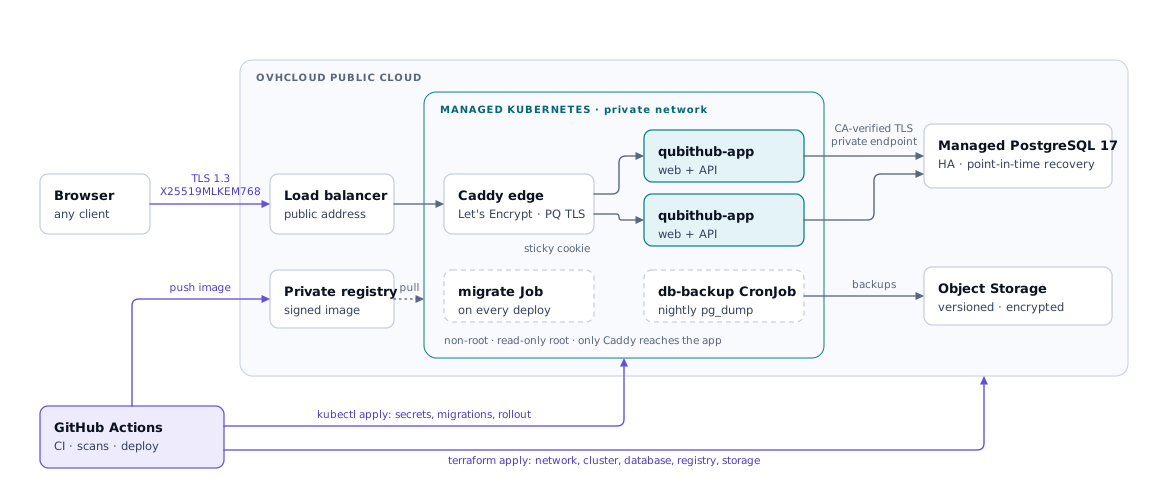
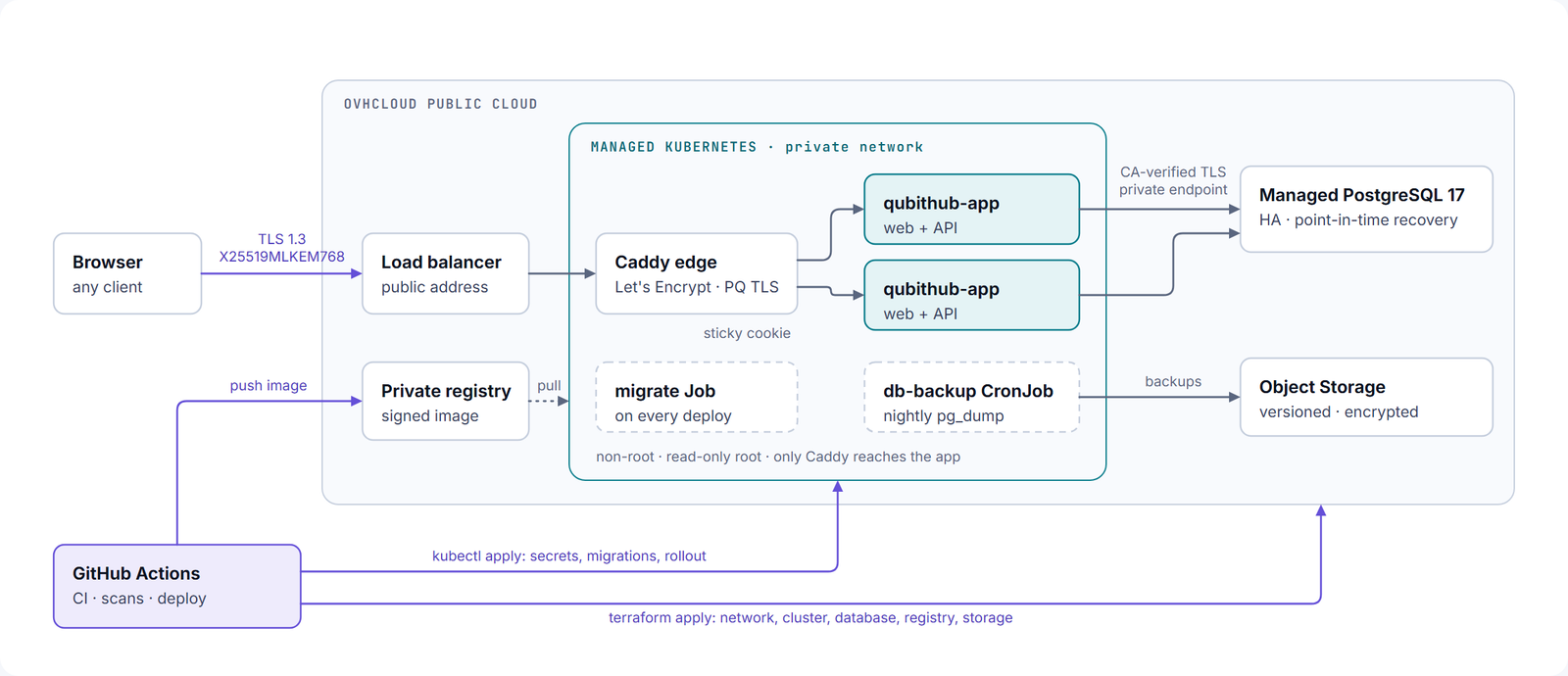
Terraform provisions the network, cluster, database, registry and storage. GitHub Actions tests, scans, builds and deploys; migrations run before every rollout.
Caddy terminates TLS 1.3 with the hybrid X25519MLKEM768 key exchange and falls back to X25519 for clients without post-quantum support.
Non-root containers with a read-only root filesystem and all capabilities dropped. Network policies let only the edge reach the application.
Managed PostgreSQL 17 on a private endpoint with daily backups and point-in-time recovery, plus nightly dumps to versioned, encrypted object storage.
Lint, type checks, tests against a real PostgreSQL, container and dependency scans, CodeQL analysis and a software bill of materials with every release.
What is real today
| Component | Today | Needed for production use |
|---|---|---|
| Circuit simulation | Real classical state-vector simulation of up to 20 qubits, with seeded sampling | High-performance simulators for larger circuits |
| Quantum hardware | None. Aurora-7 and Kestrel-27 are fictional device profiles with an approximate noise model | A provider SDK and credentials in the server-side gateway |
| Accounts and roles | Real accounts: approval, password and one-time code, roles enforced on the server | In place |
| Catalog and statistics | Fictional seed data, labelled as sample or self-reported | A catalog service and storage |
| Queues and failures | Simulated by a mock provider, labelled as such | Provider status interfaces |
| Billing | Not configured. Nothing can be purchased or charged | A payment provider with server-side checkout |
The platform at qubithub.io: catalog, Playground, job API, industry demos, reports and real accounts.
Closed beta: every account is approved by hand and given a role.
A first hardware provider, connected through the job API gateway.
Premium Business for teams, once billing is configured.
Planned items are intentions, not commitments, and carry no date.
Plans
Learn, experiment and publish in the open.
Private, auditable quantum workloads for teams.
Billing is not configured. Plans and quotas are built and shown for illustration; no payment details are collected and nothing is charged.
Request access and say which role you need. Every account is approved by hand before the first sign-in.