Approval before access
New accounts are pending until the super admin approves them and assigns a role. The super admin role can never be requested or granted from the interface.
Security
For both products, Qualimetrix documents where data is processed, who can reach it, how long artefacts are kept and what risk remains. Neither product replaces identity, endpoint, infrastructure or software-supply-chain security.
Shared by both products
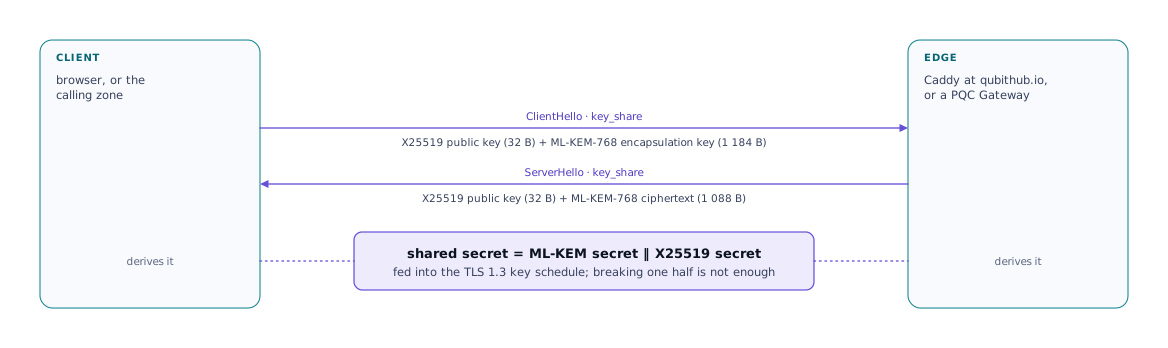
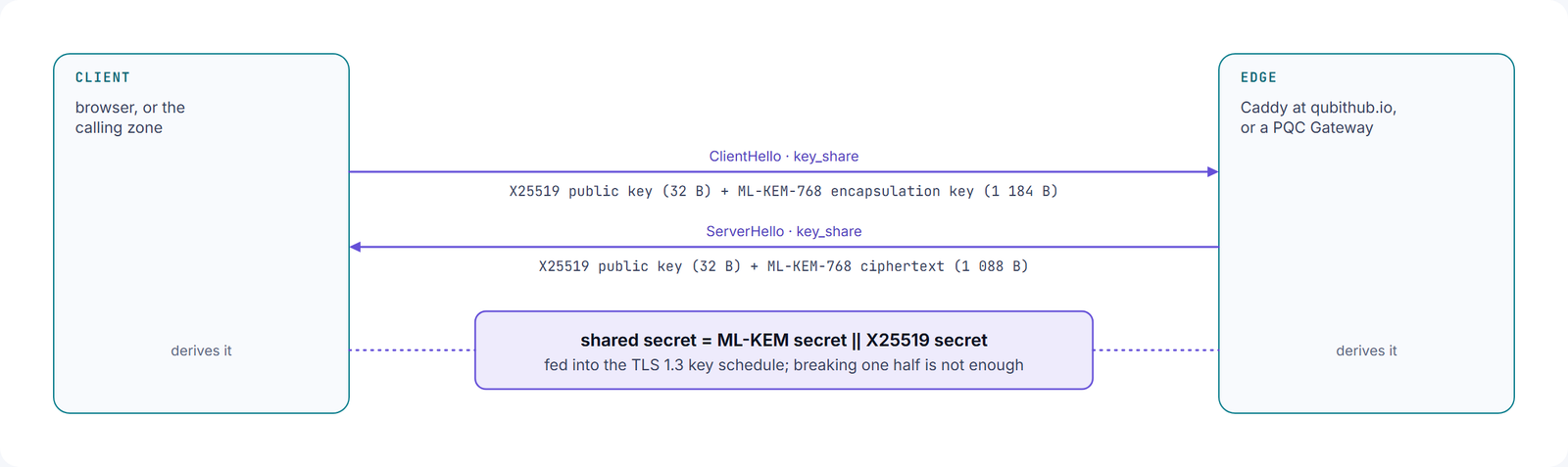
Both products use the same hybrid key establishment. It is live at the edge of qubithub.io today, and the Continuum PQC Gateway uses it in its live non-production zones, such as app.continum.host.
X25519 and ML-KEM-768 are negotiated together, so a failed post-quantum half still leaves the session classically protected.
The certificate signature at the edge is still classical: public certificate authorities do not yet issue post-quantum certificates. Hybrid key establishment protects against recording traffic now and decrypting it later, not yet against an active attacker with a quantum computer.
QubitHub
Only the pages needed to sign in, request access or reset a password are public. Every other page and every interface of qubithub.io requires a valid session.
New accounts are pending until the super admin approves them and assigns a role. The super admin role can never be requested or granted from the interface.
A password plus a six-digit one-time code from an authenticator app, with ten single-use recovery codes. Codes cannot be replayed, attempts are limited and accounts lock after repeated failures.
Argon2id with a server pepper for passwords, HMAC for one-time codes, 256-bit random session tokens stored as SHA-256 hashes, and AES-256-GCM for authenticator secrets at rest.
Cookies that scripts cannot read, sent only over HTTPS and only to the same site. Twelve hours absolute and two hours idle, revocable on the server at sign-out, password change or suspension.
Origin checks on every state-changing request, a strict content security policy, HSTS, and rate limits globally and per sign-in endpoint.
Sign-ups, approvals, rejections, role changes, sign-ins, failures, lockouts, resets and removals are recorded and visible in the admin console.
Non-root, read-only root filesystem, all capabilities dropped. The namespace enforces the restricted pod security level and only the edge proxy may reach the application.
The browser never handles provider credentials. A job for a remote provider goes to a server-side gateway that holds them in its own environment.
The job interface runs the classical simulator and keeps jobs in process memory. Catalog, dashboards, billing and reports still use labelled sample data.
Continuum
The PQC Gateway can keep its TLS key in the customer HSM through PKCS#11, so the key never leaves it; in the current pilot zones the key is a Kubernetes secret. Every session is recorded under its zone policy.
Deployment modelDocumented controls reduce risk; they do not remove it. Residual risk is stated per deployment, and a control that has not been tested is recorded as untested rather than as present.
Current scopeReporting
Reports go to compliance@qualimetrix.nl. Qualimetrix acknowledges a report, states whether it is in scope, and reports back on remediation. Certification status is stated plainly: ISO/IEC 27001 is in preparation and is not held today.